Showing posts with label recipes. Show all posts

Sunday, October 28, 2012

Penne with Sausage, Mushrooms and Collard Greens

It's always exciting to watch the summer fruits transition to fall vegetables. Several farmers had shiitake mushrooms for sale this week. I combined them with a few leaves of collard greens and built a rich pasta sauce. It's a great recipe for this time of year because all the vegetable are in season and available locally.

Penne with Sausage, Mushrooms and Collard Greens

2 tbs olive oil
3 tbs butter
1 pound sausage, casing removed
4 cloves garlic, diced
8 oz mushrooms, sliced
5 collard leaves, julienned
1 15-oz can of diced tomatoes or 3-4 fresh
1/2 cup dry white wine (I used sauvingon blanc)
1 tbs fresh parsley or 1 tsp dried
1/2 cup Parmesan or Pecorino cheese
1 box penne

1. In a saucepan add the oil, brown the sausage and remove it from the pan.

2. Fill a pasta pot with water and bring to a boil. Don't forget to add salt to the water. 

3. In the now-empty saucepan, melt the butter, then add the garlic. When the garlic is fragrant but not brown, add the mushrooms.

4. When the mushrooms have released their water, add the collards and tomatoes. Simmer for 5 minutes, then add the wine and simmer for 5 more minutes. 

5. Add the sausage, parsley, pasta and cheese. Toss, garnish with additional oil, parsley, collards or cheese and serve.

Sunday, October 14, 2012

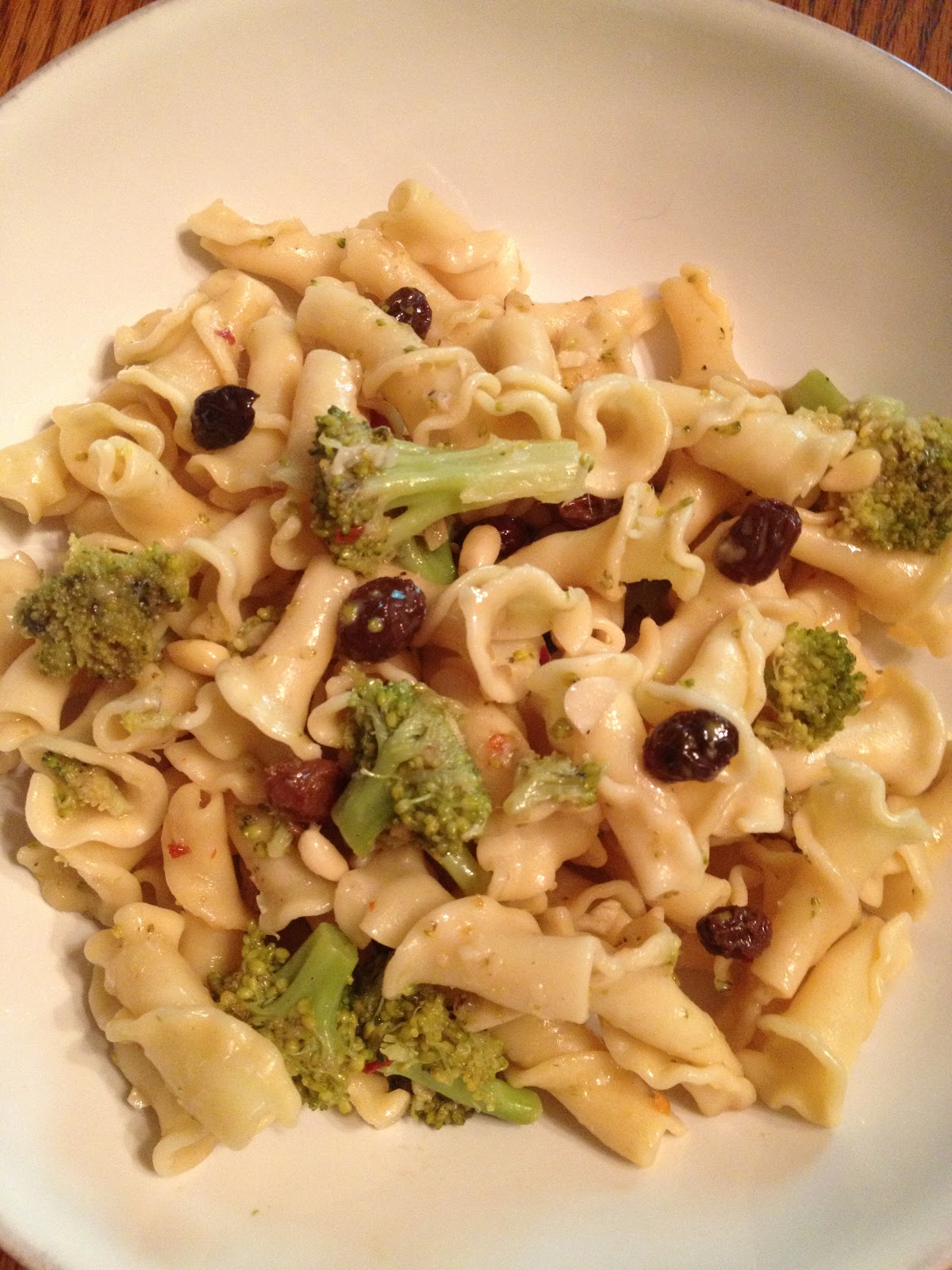
Campanelle with Broccoli, Sicilian Style

I bought a head of broccoli at the market this weekend and wanted it to last more than one meal. Recalling an old recipe for orecchiette with broccoli from a cookbook my dad brought home from Venice, I adjusted the ingredients to fit what I had on hand. The combination of pine nuts, raisins and chile flakes with pasta isn't for everyone, but I think it rocks.

Campanelle with Broccoli, Sicilian Style

1 large head of broccoli
1 box short pasta
4 anchovy fillets (about half a can)
4 cloves garlic, diced
1 small handful of pine nuts
1 even smaller handful of raisins
chile flakes, to taste
grated Pecorino Romano cheese, to taste (1/4-1/2 cup)
4 tbs olive oil
salt 

1. Fill a pasta pot with water and bring to a boil. Add salt and the broccoli. Remove when it's cooked but still firm and soak it in cold water to stop the cooking process. Use the same water to boil your pasta. Remove the pasta about two minutes before it's fully cooked.

2. heat the olive oil in a saucepan, then add the garlic. When the garlic is fragrant but not brown, add the anchovies and chile flakes. Let the anchovies cook until they dissolve. Add a little broccoli water if necessary to keep the pan from drying out. 

3.  Add the pine nuts, raisins, broccoli and simmer for 5 minutes. Then, add the pasta. Mix well and add enough pasta/broccoli water to cover the bottom of the pan. Simmer until the pasta's al dente, add the cheese, toss and serve immediately. 

Sunday, September 16, 2012

A Sicilian Salsa Cruda

I wrote about the wonders of fresh tomatoes last summer, particularly in a raw tomato sauce, also known as salsa cruda. I've always viewed salsa crudas as exlcusive to the summer, but that's not always the case in Sicily. Just because tomato season is coming to an end doesn't mean you have to start cooking all of your sauces again.

A recipe for salsa cruda in a Messina News article published in August 2010 provides a variation that includes, but does not necessarily feature, the tomato. It calls for ten cherry tomatoes, but they are just the backdrop for bold flavors like pistachios, almonds, anchovies, capers and orange. It's great with pasta, bread or grilled meats and fish.

I've translated (with help from Google) and copied the recipe below:

SALSA CRUDA ALLA SICILIANA

Ingredients for 4 people:
 

2 tablespoons pistachio nuts 
2 tablespoons almonds
1 tablespoon capers
2 anchovies, in oil
10 Pachino cherry tomatoes 
some basil leaves 
½ an orange, peeled and cut into wedges
extra virgin olive oil
salt (if needed) and pepper.

preparation:
1. Drain the capers and rinse them again under running water.
2. Drain the anchovies.
3. Place capers and anchovies in a blender and blend together with all other ingredients. 

4. Add the oil and season with salt and pepper.

Recipe courtesy of Fragolosi 

Sunday, August 26, 2012

Basic Vodka Sauce

Last Sunday was my last day of summer vacation, as teachers reported back to school Monday for our annual week of work to prepare for the students' return on the twenty-seventh. To commemorate a great summer, I threw a pile of padron peppers in a frying pan, defrosted a box of Christopher Sauce, boiled a box of pasta and called it a party.

The padrons were so spicy that we all needed a beer before moving on to the pasta. Instead of crab and egg crepes, I kept it more traditional this time with sausage and rigatoni.


Vodka Sauce with Sausage 
Serves 4

1 pound sausage, casings removed
6 tbs olive oil
5 cloves garlic, diced
1+ tsp crushed red pepper
1 28-oz can crushed tomatoes or 2 cups Christopher Sauce  or 2 pounds fresh tomatoes, cored, peeled and chopped
1/2 cup vodka
1 cup cream
1/2 tsp black pepper
12 fresh basil leaves, chopped or 1 tsp dried basil
salt

note: If you're using Christopher Sauce, you can skip steps 2 and 3. 

1. Heat 2 tbs olive oil in a sauce pan, then brown the sausage.

2. Remove the sausage and add the remaining 4 tbs oil and garlic. 

3. Before the garlic begins to brown, add the crushed red pepper and let cook for 30 seconds.

4. Add the tomatoes or Christopher Sauce. Simmer for 10 minutes, then add salt to taste.

5. Add the vodka, stir, and let simmer for another 5 minutes.

6. Add the cream, black pepper and basil. Stir and lightly simmer for 5 more minutes.

7. Transfer the sauce to a blender or food processor and mix until it becomes a rough puree. 
8. Return it to the pan and add the pasta and sausage. Toss, simmer for a couple more minutes and serve.

Thursday, December 22, 2011

Shrimp linguini with collard greens

North Carolina's mild winters allow some crops to grow year-round. The best greens of the year come during the winter, when the cold temperatures increase the sugar content in the leaves and give everything from lettuce to kale a crisp texture and sweet flavor.
 Collard greens are especially abundant, inexpensive and nutrient-rich. You can saute them with anchovies and lemon juice and serve them as a side dish, or add eat them with pasta and shrimp like I prefer. 

Friday, November 18, 2011

Don't Throw Away Your Carrot Tops

Last weekend I watched a market vendor cut the greens from a bunch of carrots and throw them into a large bin before handing the orange roots to a customer.

"What do you do with the greens?" I asked as I paid her for my own bunch.

"Feed 'em to the rabbits," she said.

"You don't cook with them?"

"We never have," she said. "The greens are chewy, and they taste like...carrots."

Intrigued, I kept my greens and asked her for extra from her rabbit bin.

"Knock yourself out," she said. "and let me know what you come up with."

I tasted a stalk and agreed that they are indeed chewy. And the greens do taste like carrots, but the texture and small leaves also remind me of parsley. Surely there's a meal that can utilize this forgotten part of one of America's most common vegetables.

As I thought of the foods most commonly paired with carrots - celery and onion in soups, cabbage in coleslaw, nuts and cream cheese in carrot cake, etc. - I recalled market director Erin Kaufman's recent note about pesto in her weekly email:

The word pesto originates from the Italian word ""pestare", which means to pound.  Pesto is just an adjective that means "pounded".  When we think of pesto, basil immediately comes to mind, since it is common and delicious sauce for pasta, potatoes, etc.  This week, after an illuminating conversation with Phoebe from Scratch (and a piece of pie that included radish top pesto), I was reminded that you can make pesto out of all kinds of things.  And right now, the Market is bursting at the seams with green things that you can pound up into a delicious paste that you can add to all kinds of dishes.
I'd seen pesto recipes that called for parsley to compliment basil and arugula. Since pesto is a good way to break down large quantities of greens and herbs into small but potent servings, why wouldn't it work with carrot greens?

It felt like a proud moment of culinary trail blazing (though I'm far from the first person to make carrot green pesto), and the result works great on sandwiches (especially leftover turkey sandwiches...), sitting on the surface of a bowl of soup, and even tossed with roasted potatoes.

Carrot Green Pesto
2 large handfuls carrot greens, stems removed
2 garlic cloves
1 small handful roasted almonds
15 basil leaves 
1/4-1/2 cup olive oil, depending on desired taste and thickness
1 handful Parmesan cheese
salt and pepper

1. Combine the carrot greens, basil, garlic and almonds in a mortar and pestle or food processor.

2. As you mix, pound or pulse the ingredients into a paste, slowly add the olive oil until you reach the desired thickness.

3. Add the cheese, salt and pepper and serve. 

**Note: to thin pesto, add additional oil. To thicken it, add cheese.


Tuesday, November 8, 2011

Diwali 2011

For the first time since moving to the U.S. in 2001, Shefali celebrated the Diwali holiday in style by hosting a party and serving traditional Indian food.

Diwali is a Hindu celebration of lights. It occurs each fall,when a new moon arrives sometime between mid-October and mid-November (it fell on October 26 this year). Shefali's family also takes time during Diwali to honor Laksmi, goddess of wealth. They usually celebrate with fireworks, alcohol, gambling, and of course great food.


In preparation, we woke up early Saturday morning and drove to Cary's "little India" district to shop for authentic groceries like chaat masala, tandoori paste (I have never tried making my own), bitter mango, desi dahi and green chutney. After we hit Patel Brothers' grocery store we bought fresh kaju katri and golab jamun from Mithai across the street. The guys at Mittai make traditional desserts in-house, and they're the best we've had on this side of the world.

We returned home and began cooking around 2:30. Shef made a huge batch of her mother's world famous chicken curry while I threw together the kachumber, eggplant bhartha and broiled okra. The meal came together around 7 p.m., just as twelve friends and neighbors climbed our candle-lit staircase and joined us to feast.

After dinner we crushed the desserts, then laid a bed sheet on the living room floor. In honor of Laksmi, everyone drank beer and played poker. It was a great way to celebrate and share the holiday with others, especially since several of our friends ate (and loved) Indian food for the first time.

Diwali will likely become an annual affair, as we're already talking about how bottles of Kingfisher, Bollywood music and fireworks will make next year's party a real bash. Until then, enjoy the recipes.

Arati's Eggplant Bhartha

1/2 cup spring onions, chopped
3 large eggplants
1 15-oz can diced tomatoes
2 tsp corriander
2 tsp cumin
2 tsp turmeric
1 tsp red chili powder (to taste)
fresh cilantro
salt, to taste

1. Roast the eggplant in a 400-degree oven until the skin gets quite crisp (about 25 minutes), then peel and chop into cubes. Roasting the eggplant gives it a lovely smokey flavor.  
 NOTE: If pressed for time, skip step one and simply cube the eggplant.

2. combine all ingredients and cook on low heat for approximately 60 minutes. When the ingredients are blended together and the excess water from the veggies has dried up, balance the seasonings, add a handful of cilantro leaves and serve.

Broiled Okra with Chaat Masala

1 pound fresh okra, preferably small, thin pods
3 tbs olive oil
salt
pepper
2+ tsp chaat masala

1. Set the oven to broil, then half the okra lengthwise and toss with the olive oil and chaat masala.

2. Arrange the okra in a baking dish, skin side down, and broil until crisp, about 30 minutes.

3. Add additional chaat masala to taste and serve. 


Wednesday, October 12, 2011

Vodka Sauce - a Variation

One way to quickly judge an Italian restaurant's menu is to scan the number of different sauces it pairs with pasta. All too often restaurants will serve a dozen different pasta shapes "tossed in a cream sauce." It's hard to screw up a cream sauce, since large doses of dairy (like heavy cream) can mask even the most horrendous sauces. When I see a menu full of cream sauces, I immediately lower my expectations.

That does not, however, mean that all cream sauces are garbage.

One way to build great flavor into a cream sauce is to add liquor, let the alcohol cook away, then add the cream. This will give you a base of flavors in the sauce that the cream won't overwhelm.

A great example is the brandy cream sauce at Bocci. Its bold flavor includes, but isn't limited to, the cream that thickens it. Plus, it's great with seafood. Bocci's former (Sicilian) chef, Michelle Rizzo, used to offer a dish called "crepes alla Michelle," featuring shrimp and scallops in the brandy cream sauce, served over an egg crepe instead of pasta. It was my favorite meal on the menu.

One of Shefali's favorite sauces is the more traditional vodka sauce. Often served at restaurants with sausage and penne, the vodka, black pepper, and crushed red pepper makes it spicier than most cream sauces. We make it at home regularly and experiment with different ways to serve it.

I've found that crab meat works especially well with vodka sauce. It's a lighter protein source than sausage, which works well because it offsets the heavy cream, and the sweetness of the crab meat compliments the acidity from the tomatoes. In honor of chef Rizzo, we eat it over eggs.

Vodka Sauce with Crab Over Crepes

Serves 4

1 pound (or more) lump crab meat, cooked
4 tbs olive oil
5 cloves garlic, diced
1+ tsp crushed red pepper
1 28-oz can crushed tomatoes or 2 cups Christopher Sauce  or 2 pounds fresh tomatoes, cored, peeled and chopped
1/2 cup vodka
1 cup cream
1/2 tsp black pepper
12 fresh basil leaves, chopped or 1 tsp dried basil
salt

1. Heat the olive oil in a sauce pan, then add the garlic. 

2. As the garlic begins to brown, add the crushed red pepper and let cook for 30 seconds.

3. Add the tomatoes or Christopher Sauce and simmer for 10 minutes. After 10 minutes, add salt to taste.

4. Add the vodka, stir, and let simmer for another 5 minutes.

5. Add the cream, black pepper and basil. Stir and simmer for 5 more minutes.

6. Transfer the sauce to a blender or food processor and mix until it becomes a rough puree.

7. Return it to the pan, add the crab, simmer for a couple more minutes and serve.

Egg Crepes

8 eggs
1/4 cup milk or cream
2 tbs olive oil or butter
salt

1. Beat eggs together with milk and salt.
2. Heat the olive oil in a skillet, then add 1/4 of the egg batter.
3. Let the batter set. Run a spatula underneath it to keep it from sticking. Flip the egg once, let it cook through, then slide out of the pan.
4. Roll the crepe on a plate and top with the sauce.
5. Repeat.

Wednesday, September 14, 2011

Grilled Peaches with Rasberry-Balsamic Sauce

The Christopher males are not known for their desserts, but I mentioned in last week's post that my dad made a very simple one that everybody loved. The sauce features two different kinds of summer fruit and works well as a topping for many different foods. Apparently my mom puts it on everything from bananas to cottage cheese.


Grilled Peaches with Rasberry-Balsamic Sauce


2 pints ripe fresh raspberries
2 Tbs balsamic vinegar
3-4 Tbs sugar depending on how sweet you like it
3 Fresh ripe peaches
2Tbs butter
2 Tbs brown sugar
Vanilla ice cream
 
1. Combine the sugar and balsamic vinegar in a saucepan and heat until sugar is fully dissolved.  
 
2. Slightly crush the raspberries and add them to the saucepan.  Cook on medium heat for 10 minutes while stirring routinely.  
 
3. Once it's done, you can serve as is or put the mixture through a sieve to remove the seeds for a smooth sauce.  The sauce can be kept refrigerated for 1-2 weeks.
 
4. Cut peaches in half and remove the pit. 
 
5. Combine brown sugar and butter in a pan and heat until sugar dissolved.  While the mixture is still hot, brush the peaches with the mixture on the flesh side.  
 
6. Put the peaches flesh side down on a hot grill. Grill until they are glazed and the peaches begin to soften.
 
7. Place a peach in a bowl, add a small scoop of vanilla ice cream and cover with your raspberry sauce.

Tuesday, September 6, 2011

A Family Meal, Starring an Unfamiliar Leaf

The Ohio Christophers visited us for Labor Day weekend. Any time the family gets together an epic meal occurs, so before everyone went to work building nursery furniture, throwing a baby shower and watching college football, I took them to the farmer's market for inspiration.

The market was as busy as I've ever seen it, but that didn't stop us from picking up fresh peppers, onions, garlie, eggs and sweet potato greens. That evening, we recreated Tony's Three Pepper Parade along with fresh fetuccine, sauteed sweet potato greens (recipe after the jump), tomato and bean salad and grilled peaches with ice cream and a rasberry-balsamic sauce for dessert.

Tuesday, August 30, 2011

Three Pepper Parade

This week's post comes from Cleveland, where my brother used local meat, produce and pasta to create a most excellent photo and meal.

Hello blogger friends! This weekend I used a variety of ingredients from my Fresh Fork CSA basket and made a dynomite Italian dish.

I call it "Italian Three Pepper Parade," or stuffed bell and banana peppers over red pepper pasta. Here's how I did it:

Tuesday, August 23, 2011

Pasta Alla Norma

I took another trip to the farmer's market on Saturday...and came home with four more pounds of eggplant. This week, it went into pasta alla Norma.

Pasta alla norma is almost as old as the island of Sicily itself. Named after the heroine in Vincenzo Bellini's famous opera, Norma, the two-act performance tells the story of the Druid priestess Norma, whose husband Pollione tries to run away to Rome with the Adalgisa, another priestess. Out of loyalty to Norma, Adalgisa tells her about the affair. Norma considers murdering her two children but decides to leave them with Adalgisa instead. Adalgisa, however, then renounces her love for Pollione and urges him to return to his wife.


Infuriated, Norma calls a meeting with the Druids and declares war against the Pollione's Romans. The declaration requires a sacrifice, which conveniently presents itself when Pollione is caught entering the temple of virgins to visit Adalgisa and is subsequently sentenced to death. Minutes before Pollione's execution Norma, deeply saddened by the turn of events, decides to take his place. Inspired by her benevolence, Pollione rekindles his love for his wife and joins her in the pyre.

First produced in 1831, Norma was immediately hailed a success, so much so that people began using the title as a term of endearment. For example, one's favorite music could be called "musica alla Norma," the best poetry "poesia alla Norma." As the pasta became one of Sicily's most famous dishes, it became known as pasta alla Norma.

I don't know about you, but all this talk about lyric tragedies is making me hungry. Let's move on to the recipe.
The innumerable variations of this recipe typically include:

- eggplant, fried in oil before its added to the sauce
- tomatoes
- cheese
- pasta
-a spicy pepper
-fresh basil

Here's my take:

Pasta Alla Norma

vegetable oil 
olive oil
2 pounds eggplant, cut into 1/2" cubes
4 cloves garlic*
2 tsp salt 
crushed red pepper, to taste
1 big can of diced tomatoes or 2 cups Christopher Sauce or 2 cups fresh tomatoes, peeled and diced
12 fresh basil leaves, roughly chopped
1/4 pound roughly-grated ricotta salata**
1 box short, tubular pasta, like penne or rigatoni

*If you're using a premade sauce (that already includes garlic) instead of tomatoes, consider reducing or omitting the garlic

**Ricotta salata is salted sheep's milk ricotta cheese. It's much more firm than regular ricotta. Substituting ricotta produces a smooth, creamy sauce that's different in texture but equally raucous. Another option is to substitute another firm, salty cheese like pecorino romano. 

1. Placed the diced eggplant and salt in a strainer with a bowl underneath, then put something heavy on top. Let the eggplant sit for an hour. During this time, the salt will pull the bitter juices from the eggplant pieces into the bowl underneath the strainer. 

2. Fill the bottom of a saucepan with 1/4" of vegetable oil. When the oil is hot (test it), add the eggplant.

3. Stir the eggplant frequently as it fries, being careful not to break the pieces. Add more oil if necessary. When the eggplant has turned golden brown, remove them with a slotted spoon and place them on a plate lined with paper towel to dry. 

**Note: now would be a good time to begin boiling your pasta water

4. Discard the vegetable oil from the pan. Wipe the pan clean and return it to medium heat. 

5. Add 2 tbs olive oil to the now empty saucepan. Just before the oil begins to smoke, add the garlic. As the garlic begins to brown, add the crushed red pepper and let simmer for 30 seconds.

6. Add the tomatoes and simmer until the sauce thickens, 5-10 minutes. 

7.  When the sauce has reached its desired consistency, add the eggplants and fresh basil and let the sauce simmer on low heat for 5 more minutes.

8 Serve the sauce over pasta and garnish with grated cheese and additional basil. 


Monday, August 15, 2011

All Hail the Tomato

Growing up in Iowa, summer really hit its stride when the tomatoes began to ripen. I knew they were ripe when I could smell the plants themselves - the earthy aroma of the vines - from the porch in our backyard, 50 feet from the garden. When the time came to pick them, my mom would take a basket and ask for my help. I'd look for the ripe ones, asking for her approval before picking the first two or three. After I got the hang of it I'd sneak away, find the biggest one on the vine, pluck it and eat it like an apple. The juices would run down my face and the seeds would stick to the collar of my shirt, but she'd only smile and encourage me.

"That's the best way to do it!" she'd say. "Eat as many as you can."

She wasn't as encouraging when I tried it with an expensive store-bought tomato in December, but it happened only once because I immediately learned that the two shouldn't even be in the same food group.

Now that it's tomato season, I urge you to do two things:

1. Pick a tomato off a vine and eat it like an apple. Don't wash it, don't bring it inside the house. Eat it right there, next to the vine, preferably barefoot.

2. Cook them as little as possible, if at all.

Fresh tomatoes are obviously great in salads and on sandwiches. They also make the best pasta sauces. Every year I buy upwards of 10 pounds of San Marzanos, core, peel and seed them and make old-fashioned sauce. This, however, takes quite a bit of time, both outside in the heat during the day acquiring them and later over the heat of the stove.

Most summer nights I'd rather eat them raw with pasta. It's a popular choice in Italy as well, often called "salsa fresca" or "salsa cruda." I dice the tomatoes, add olive oil, garlic and fresh herbs and toss it with the pasta as soon as it leaves the boiling water. The sauce is never cooked, but the pasta and residual cooking water heats everything just enough to blend the flavors.

I never measure the quantities of the ingredients I use in a salsa cruda, so it's hard to call it a recipe. However, NY Times food writer Mark Bittman provided a list of his favorite summer tomato recipes last week. One of his 12 very simple recipes is nearly identical to my own salsa cruda:

Mark Bittman's Salsa Cruda for Pasta (or Anything Else)

Ingredients
1 1/2 pounds tomatoes, chopped
3 tablespoons olive oil
3 garlic cloves, light crushed
1/2 cup chopped basil
1/2 pound pasta
Preparation
1. Mash together tomatoes, olive oil, garlic cloves and chopped basil. 

2. Let sit while you cook pasta, then fish out garlic and toss (add some pasta-cooking water if necessary). 

3. Garnish with more chopped basil.

Monday, August 8, 2011

Caponata

There are great veggies in season at the farmer's market this time of year, like fresh onions, eggplant, tomatoes and sweet bell peppers. This also makes it a great time of year to make a huge supply of caponata.


Caponata is an ancient Sicilian relish. It's both sweet and sour, thanks to doses of sugar and vinegar, and goes great with bread as well as grilled meats and fish. Similar to pepperonata, the addition of meaty chunks of eggplant, olives, capers and dried fruit make it authentically Sicilian. It's also a great way to cool off a summer dinner, as its served at room temperature or colder.

Monday, August 1, 2011

A Walking Fish Special Delivery

Walking Fish finished its summer deliveries last month while we were out of the country, so our shares of shrimp went to a friend. Of all the great seafood deliveries people rave the most about the fresh shrimp, so I was disappointed I missed it.

Luckily, Walking Fish offered a one-time shrimp delivery in July to appease those who couldn't wait for the white shrimp this fall. I jumped on it and cooked them as soon as I picked them up.

I remember my parents cooking fresh shrimp during our family vacations at the Outer Banks. They served them plain, with cocktail sauce or tossed in Old Bay seasoning and butter. Fresh seafood needs little, if any, seasoning, so I prepared mine using only what I had on hand at the house.

Land Locked Summer Shrimp

2 lb fresh shrimp, peeled and deveined
6 tbs olive oil
1 tsp crushed red pepper (optional)
4 cloves garlic, chopped
1 lemon
12 cherry tomatoes, halved
1 handful fresh parsley

1. add 4 tbs olive oil to a very hot pan. Just as the oil begins to smoke, add the shrimp. Sear shrimp for about 3 minutes, then flip and cook for another 2 minutes. Be careful not to overcook.

2. When the shrimp is cooked through, remove from the pan and set aside. In the now empty pan, add 2 tbs olive oil. 

3. When the oil is hot (beginning to smoke), add the garlic.

4. As soon as the garlic begins to brown, add the crushed red pepper (if you want it spicy). 30 seconds later, add the tomatoes. 

5. When the tomatoes begin to wilt, cut the lemon in half and squeeze the juice from one half of it over the pan and stir. The lemon juice should deglaze the bottom of the pan.

6. Return the shrimp to the pan, add the parsley and stir. Season with salt and pepper.

We ate it with crusty bread and salad.


Monday, July 25, 2011

Carolina BBQ - Old School

My brother visited from Cleveland last weekend, and the July heat and humidity here in NC nearly made him shave his grizzly beard. After spending much of Saturday outside, I couldn't think of a better way to help him relax than showing him the southern tradition standing over a smoking grill for an hour and a half.

Without the time to barbecue a big piece of pork and a traditional meat smoker, we used a charcoal grill and chicken instead. Many steps, several hours and multiple cold beverages later, we reeked of smoke but didn't care because the food was awesome.


Here's how we did it.

Monday, July 18, 2011

Gluten Free Chicken Parm

One thing Indian and Italian families seem to have in common is the tradition of eating your way through family visits. Meals tend to be long, frequent and excessive, and after awhile you forget what it feels like to be "hungry." My brother-in-law, Manek flew down frown New York with his girlfriend this weekend, so we acted accordingly.

Manek's favorite Italian dish is Chicken Parmesan, so we make it at home every time he visits. These days, however, he's following a gluten and dairy free diet, so we had to get creative. I don't remember my family making Chicken Parmesan growing up, so I learned from Mario Batali. This time, we made a few adjustments, the most obvious one being serving it with polenta instead of pasta. We also only coated the chicken in bread crumbs and not flour - something I would change next time.

Regardless, it turned out pretty awesome.


Monday, July 11, 2011

Arati's Chicken Curry

Tracking down family recipes isn't easy. The mothers who made the meals famous learned from their mother or mother-in-law over the course of many years of coaching and supervision, so that the technique becomes part of her DNA long before it's ever written down. Perhaps this is part of what makes "home food" so awesome, as it's about about the people and the place as much as the recipe. Try as we may to recreate it on the other side of the world, it's not always easy to replicate.

One morning, before the rest of the family was up and moving, I camped out in my mother-in-law's kitchen while she cooked the day's basic chicken curry - the same chicken curry she's prepared for lunch each day for the past 31 years - and wrote down her every step.


Saturday, April 16, 2011

Mullets in Style

Our spring subscription to walking fish began this week with a bag full of fresh mullets, also known as kingfish or whiting. My fish were small with firm, white flesh, so I wanted to cook them whole. Having never worked with mullet before, I looked for a Sicilian recipe and immediately found Triglie di Scoglio, or "red mullet in onion sauce."

Triglie di Scoglio

- five small
Walking Fish mullets, gutted and whole
- flour
- two eggs, beaten
- vegetable oil
- olive oil
- two yellow onions, sliced thin
- 1/2 cup white wine or sherry vinegar
- 1/4 cup sugar

1. Cover the bottom of a pan with vegetable oil and heat until shimmering.
2. Dredge the fish in flour, then then egg mixture, then back through the flour.
3. Fry each side of the fish until golden brown. If your pan is hot, this will take less than five minutes per side. Make sure the fish is cooked through before removing.
4. Once all the fish have been fried, remove the vegetable oil, add the olive oil and heat until barely smoking.
5. Saute the onions over low heat, turning occasionally, until translucent.
6. Add the vinegar and sugar. Stir until the liquid thickens, then add salt and pepper to taste.
7. Serve the fish with the sauce or pour the sauce over the fish. Serve with lemon.


Although I later learned that the red mullet found in the Mediterranean are quite different from the sea mullet caught off the Carolina coast (the two fish aren't even in the same family), it was a quick, easy and flavorful meal. The tangy onion sauce would work well with other fish or chicken. Researchers at bestofsicily.com write that "traditionalists believe this dish is best served slightly chilled or at room temperature." After eating it at room temperature last night and cold this afternoon, I agree that it works both ways.

We ate it with mashed potatoes and stewed collard greens.

Thursday, March 31, 2011

Recreating an Irish Feast

I spent my summer in Ireland in 2005, studying creative writing at National University Ireland-Galway. Traveling the country and visiting pubs stretched my student budget to its limit, so I had little money to spend on fine dining. In fact, I ate so cheap that even store-bought jars of pasta sauce were fair game.

Nevertheless, I have nothing but fond memories of Irish food. I ate shepherd's pie in Dublin, a terrific stew in Cork, fish and chips in Galway's city center, and a chocolate caramel biscotti topped with ice cream and a signature sauce (still the best dessert I've ever eaten) on the remote island of Inishbofin. When I did decide to dine out, it was usually for lunch at a pub. One rainy afternoon early in my stay I tried a bowl of seafood chowder, and from that moment forward I was hooked.

Pubs in every coastal town I visited featured their own variation of this hearty soup. It was rich, creamy, chock full of seafood, served with hearty soda bread and great with a pint of stout.

I ate it everywhere, but two particular bowls stand out in my memory. The first found me in Cobh, a tiny coastal town east of Cork famous for being one of the Titanic's final stops. The morning after New Zealand killed the British and Irish Lions in the second match of the rugby team's world tour, my friends and I were out shopping and stepped into a pub for an early lunch. This particular pub had a large display case of exotic desserts near the door, but I was more impressed with the soup's red color and fresh salmon, scallops and clams.

My second came from an ocean side pub in Roundstone. It was a cold, wet afternoon and my classmates and I were returning from our retreat at Inishbofin. We stepped off the ferry and ran for the nearest rooftop and dry seats. The chowder that day included bacon, cod and plenty of parsley, but the bread was even more memorable. Each piece was a dark brown color, dense and a little dry. The slices came to life with a slab of Irish butter (Irish cows are grass-fed).

Upon returning home, I spent months looking for an Irish pub that effectively recreates my Irish experience. To date, nothing compares. I crave the meal most around St. Patrick's day, and because there are only so many pubs one can try, I now take a different approach. Every March 17, I recreate my Irish feast at home.


The Soup

It was difficult to find a recipe at first, as chowder isn't authentic to Ireland and none of the Irish cookbooks I own has a recipe that resembles it. A few hours on the Internet provided some options - first on the blogs of travel writers and amateur cooks, then later on the web pages of the country's most famous chefs like Kevin Dundon, Darina Allen and Donal Skehan.

In 2009, I followed the directions of Judith Kadden. I turned to Armida Amador in 2010. Earlier this month I stumbled upon the cooking blog of Michael O'Meara, head chef at Oscar's Bistro in Galway City. He writes about how chowder recipes vary greatly by nature and experimentation is a must:

As with a great many traditional foods it is likely that chowder takes its name from the iron cooking pot in which it is traditionally cooked a Chaudière. Although the actual name chowder was first used in North America, specifically Canada in the 1730’s.The term Chowder would not be specific to a single soup but rather a number of interpretations of chowder exist ranging from rich creamy recipes through to light broth like soups often thickened with water biscuits, although all interpretations would indicate a hearty and very satisfying soup. The use of salt pork in seafood chowder is essential according to many traditionalists and will add a superb extra layer of flavour as will the use of potato. Clam chowder is possibly the most well known form of the soup and although very simple to make is one of the world’s great soups. Indeed the line between when chowder becomes a stew is often very thin indeed which makes chowder a great choice for a mid day meal on a sunny summers day. Experimentation is the order of the day when it comes to making chowder with the use of different fish and shellfish making the soup both fun to make and better to eat, although the recipe I have included may not be a chowder in the most traditional sense it will yield a hearty soup and will work a treat as a light meal or as a first course to a more substantial dinner.

His comments helped me draw some conclusions about the similarities in all the variations I'd eaten. I've concluded that a good chowder has a few universal ingredients:
- butter
- flour
- milk or cream
- veggies (onions, leeks, potatoes, carrots, celery,etc.)
- water or stock
- shellfish
- fish

It can also include some or all of the following:
- smoked fish
- tomatoes
- bacon
- white wine
- herbs and seasoning

Remembering my best meals, keeping in mind my recent attempts, taking advantage of local ingredients and borrowing much from Michael O'Meara, I created the following recipe for St. Patrick's Day 2011:

Irish Seafood Chowder

1 tbs olive oil
2 onions
2 leeks
1/2 stick butter
1/2 cup flour
1/2 pound potatoes, cubed
6 ounces bacon, cut into 1/4 inch pieces
1/2 cup cream
3 cups fish stock
1-2 pounds mixed fish (I used 1 pound clams from Walking Fish, 1/2 pound cod and 4 ounces smoked salmon)
parsley, to taste

1. Cook the bacon in 1 tbs olive oil.
2. Add the butter
3. When the butter has melted, add the onions and leeks. simmer until soft but not brown.
4. add the flour and stir vigorously for two minutes to make a roux.
5. add the fish stock and bring to a simmer.
6. add the potatoes and simmer for 10 minutes.
7. add and cream and return to a simmer.
8. add the fish and simmer until cooked.
8. add parsley, salt and pepper, to taste, and serve.

The Bread

Finding a bread recipe to complement my chowder was a much simpler task. Bread in Ireland is not a recent trend, and Coleman Andrews scoured the country, speaking to famous and family chefs in search of the best brown bread. He found several worthy of the title, and he included them in The Country Cooking of Ireland. I use Myrtle Allen's, found on page 272:

Brown Soda Bread

Butter for greasing
4 cups wheat flour
1 cup white flour
1/2 cup Irish steel-cut oatmeal or oat bran
1 tsp baking soda
1 tsp salt
2 to 4 cups buttermilk

1. Preheat the oven to 375 degrees
2. grease a baking sheet and set aside
3. mix the wheat flour, white flour, oatmeal, baking soda and salt together in a large bowl.
4. Make a well in the middle of the flour mixture and gradually pour in the buttermilk, stirring with a wooden spoon in a spiral motion from the center to the edge of the bowl. The dough should be soft but not too wet, with no raw flour left (this will probably take about 2 1/2 cups of buttermilk, but use more or less if necessary).
5. Turn the dough out onto a floured board. Flour your hands lightly, then shape the dough into a flat round about 3 inches thick. Cut a deep cross in the top of the loaf with a wet or floured knife.
6. Transfer the loaf to a baking sheet and bake for 45 to 60 minutes, or until nicely browned and the bottom of the loaf sounds hollow when tapped. (Alternately, gently push the dough into a nonstick loaf pan and bake until done. The bread should slide out of the pan easily if done.)

The Beer

This is by far the easiest part of the meal to prepare. Pour a pint of Guinnes (or two). Murphy's works as well, especially in Cork.
Bread, chowder and a Guinness. It gets better every year.