Friday, March 21, 2014

Risotto Di Mare

Lent is a great time of year to cook seafood. The clams we get from Walking Fish usually end up in linguini vongole, but dinner on Ash Wednesday needed something less routine. 

Risotto Di Mare

shrimp stock
2 cups arborrio rice
pinot grigio
1 red onion, diced
1.5 cups Christopher Sauce
1 pound shrimp, peeled and deveined
1 pound clams
fresh parley, roughly chopped
crushed red pepper
4 cloves garlic

1. In a very hot pan, sear both sides of the shrimp in olive oil. Remove before they are fully cooked.

2. In the same pan, add more olive oil and the clams. Cover and cook. Remove the clams as soon as they open.

3. In the same pan, make a simple risotto: add more olive oil, sweat the garlic and onion, add the arborrio rice and crushed red pepper and toast for 60 seconds. add the wine, let it dry out, then add warm stock slowly and steadily, stirring often.

4. When the arborrio rice is nearly finished, add the Christopher Sauce, parsley and shrimp.


4. When the rice is soft (but not mushy) and the sauce is smooth, garnish with diced hot banana, chile or jalapeno pepper and more fresh parsley and season with salt and pepper.


Friday, October 11, 2013

Chef Challenge 2013 Recap

The fifth-annual Durham Farmer's Market Chef Challenge showcased a trio of new contestants, terrific eggplant preparations and great entertainment (and eating) for all.

After Billy Cotter (Toast) announced his retirement following back to back titles in 2011 (okra) and 2012 (sweet potato), market director Erin Kaufman lined up chefs Katie Coleman of Durham Spirits Company, Mike Hacker of Pie Pushers and Justin Rakes of the The Salted Pig (coming soon) to compete for a new, locally-made trophy. She also lined local food guru Susan Sink of Tar Heel Foodie and Independent Weekly food writer Elizabeth Shestak to join me on the judging panel.

The chefs began setting up their workstations at 8:30 a.m. They learned the secret ingredient at nine,  then swept through the market, buying what they needed to feed their three judges as well as a growing crowd of on-lookers.

All the judges were very patient as I hovered over them, watching, learning and asking questions. Katie gave me a quick history lesson on the classic Sicilan pairing of eggplant and cocoa powder as she threw together a caponata of zucchini, peppers, tomatoes, onion garlic, cocoa powder, crushed red pepper, golden raisins and red wine vinegar.
Katie Coleman (right)
Mike and his assistant showed me that eggplant works well with many different types of acids, like apple cider vinegar, which they added to a food processor. They were definitely the most gregarious duo of the group, talking and tasting their way through the cooking process and sharing promoting the Pie Pushers' breakfast menu (breakfast pizza and "the best biscuits you've ever had" smothered in sausage gravy).

Mike Packer (left)
Justin and Scott took advantage of the wide variety of peppers still available at the market, quick-frying Lombardos early and adding padrons late to their eggplant chunks, slices and sauce. Throughout the cooking process, they paused to say "Baba Ghanoush!" with great enthusiasm as audience members tried to pronounce it.
 
Justin Rake (left) and Scott Markin

Friday, September 27, 2013

DFM News

Every year the Durham Farmer's Market seems to get more popular. When I first started going seven years ago it was inhabited by progressive, food-centric types and a handful of casual shoppers. Now it's quite an affair.

Parents bring lunch and watch their kids run around the lawn, chomping on fresh carrots, tomatoes and breads and chasing enormous bubbles.

Activists hand out flyers. Graduate students offer free coffee and cash in exchange for surveys. Musicians perform in every green space.


New vendors set up shop outside the market pavilion hoping to cash in on the pedestrian traffic. Local sports teams raise money for travel and tournaments. Chefs perform cooking demonstrations and hand out free samples. 
Chef Shane Ingram of Four Square

Arts and crafts markets line the nearby blocks. Food trucks line nearby Hunt Street, offering everything from breakfast pizza to slow-cooked Italian pork sandwiches.

The market itself now boasts an ATM machine on-site, a weekly donation station and venders that accept SNAP and EBT. It's also extending the Wednesday market through October 9 and holding its 5th annual chef challenge on Saturday, October 5.

The vendors remain consistently awesome, and this is a great time of year to catch both the late summer and early fall crops.

To learn more, check out the official site and get down to Foster Street next Wednesday or Saturday morning.

Saturday, September 21, 2013

The Grandpa Dom Special

The first time I visited India I noticed strings of hot peppers hanging in doorways and taxicab mirrors. They were hung, often accompanied by limes, to ward off evil. Back home in my Italian-American grandparents' house, strings of peppers had the opposite effect.

Every year my Grandpa Dom grew "hot banana" peppers, also known as Hungarian wax peppers. He'd eat them fresh, then dry the rest on strings on the back porch. Rather than drive away evil, these peppers encouraged bad behavior. Whenever he felt the urge, be it four o' clock in the afternoon or eleven-thirty at night, he'd pull peppers from the string, fry them in a boatload of oil and eat them between pieces of buttered bread. If he needed to make a meal of it, he'd eat them with sausage, eggs or both.

"The longer you cook the peppers," he used to say, "the better they get."

We paid homage to Grandpa Dom this week and fried up our own hot peppers. Here's how we did it:


The Grandpa Dom Special

8 Hungarian wax peppers
1/4-1/2 cup olive oil - enough to fill 1/4-inch of the pan
4 eggs
1/4 cup grated Parmesan cheese
salt and pepper

1. heat the oil in a skillet until it's nearly smoking
2. add the peppers whole and turn frequently. Allow them to wilt and remember - the longer you cook them, the better they get.
3. When you can't wait any longer, transfer them to the serving plates.
4. Add the eggs to the pan and fry to the desired consistency. Runny yolks work best.
5. Transfer the eggs to the plates, top everything with salt, pepper and cheese, and serve immediately with roasted potatoes or bread.

Thursday, August 1, 2013

Wild Padrons

Padron peppers might be the simplest good time I've ever had.

I first tried them in Josh DeCarolis' gnocci with okra caponata. The dish, laced with padrons and guanicale, was fantastic, but I hadn't thought of his preferred heat source until this summer at the market.

"Padrons are amazing," the vendor told me... 

"Fry them in olive oil for about 5 minutes, then finish with a coarse salt and serve as a side. It's that simple, and they're fantastic."

"She's right," the guy behind me in line added. "Serve them as a side tonight and they'll knock your socks off."

By that point, half a dozen eyes were watching me, and I wasn't ready to let them down. I bought a pint of peppers, fried them that night to eat alongside pasta norma, and subsequently searched for my footwear.

The smallest ones carried an almost bittersweet ring, while the bigger ones cleansed my nasal passages in a hurry. 

Some were sweet and tangy, others very spicy. Eating a pile of padrons was like playing Russian Roulette. And just as addicting.

The next day, I wanted more padrons. I envisioned them taking over a pot of shrimp diavolo, but my wife and I didn't want to wait for the pasta and sauce. We instead ate them on their own, waiting for the spicy ones and washing them down with beer.

Putting the kid to bed, picking at padrons and washing them down with beer has become a weekly routine for us. Our summers will never be the same.  


Monday, May 13, 2013

Walking fish + summer heat = grill

When the thermometer hit 86 degrees on Friday I grabbed a roll of aluminum foil, opened a beer and grilled my delivery of fresh seafood. If you've never tried grilling clams and whole fish, you should.

Grilled clams with salmoriglio sauce

2 garlic scapes from Four Leaf Farm
2 lemons, halved and drained
Olive oil
1/4 cup water or white wine
1 pound clams

1. Scrub the clams and set them on a sheet of foil.
2. Squeeze the juice of 2 lemons into the work bowl of a blender or food processor and make salmoriglio sauce.
3. Add the now-empty lemon halves to the clams on the foil.
4. Add a healthy dose of olive oil and the water to the clams.
5. Fold the foil over the clams and enforce with 1-2 more sheets.
6. Grill on high heat for 10-15 min. Remove them as soon as they open.
7. Dip in salmoriglio sauce or eat plain.

Grilled whole fish

- Whole fish ( I used two small bluefish)
- olive oil
- salt
- salmoriglio sauce (optional)

1. Score the fish on each side.
2. Rub each side of the fish with salt and olive oil.
3. Grill over medium/high heat. Flip once and be careful not to let the fish fall apart. I flipped my fish (they each weighed a little over a pound) after 4 minutes.
4. Pour the salmoriglio sauce over the fish and soon as it leaves the grill. The residual heat will cook the sauce and deepen its flavor.
5. Eat the large fillets of fish with silverware, then pick at the remaining bits with your fingers.
 
whole bluefish, sans head


Monday, April 29, 2013

Marinades for grilling season

April is my favorite month in North Carolina. It's warm during the day, cool at night, and insects haven't descended upon our deck.

In short, it's a great time of year to grill.

My dad made kabobs for this week's Sunday night family dinner and used three different marinades to flavor the meats. He made them in a matter of minutes and tossed them with the meats a few hours before cooking them ("the longer you marinate, the better," he says). He gives credit to Alton Brown for the beef flavors, but the chicken and shrimp recipes are his own. Try one next time you need a quick way to add big flavor.

Chicken Marinade

juice and zest of 1 lemon or lime and 1 orange
4 garlic cloves minced
1/4 cup soy sauce 
1/4 cup canola oil
salt and pepper
tablespoon or 2 of chopped fresh tarragon leaves

Shrimp

3 cloves garlic minced
1 large shallot or 2 small minced
2 TBS fresh thyme or 1 Tbs dried thyme
1/4 cup chopped flat leaf italian parsley
1 tsp chili flakes- I used chipolte chili flakes
1/4 cup olive oil
juice from half a lemon- about 2 tbs
 
Steak

3 cloves garlic, minced
2 teaspoons smoked paprika
1/2 teaspoon ground turmeric
1 teaspoon ground cumin
1 teaspoon kosher salt
1/2 teaspoon freshly ground black pepper
1/3 cup red wine vinegar
1/2 cup olive oil

Thursday, February 28, 2013

Winter Vegetables and healthy diets

NPR ran an excellent story this week about yet another study that concluded a Mediterranean diet is a healthy way to eat, particularly for your heart.

The study concludes "a diet rich in olive oil, fish, nuts , fresh vegetables and wine" can dramatically reduce the risk of heart attack and stroke." But in addition to reporting the research findings, Gerry Hadden also visits a small restaurant along the coast of Spain and asks a local restaurant owner why he thinks the diet works so well.

"Everyone already knows our diet is healthy," said Pepe Bache, owner of The Room Service. "Generally speaking, our diet is fresher because of the warm weather. It lets you grow crops most of the year and offers variety."

"Every region of the world ought to have their so-called Mediterranean diet," Sandra, the restaurant manager, added. "That is, you eat what grows where you live and you eat it in season. If you want to eat well, you can't expect to eat mangoes in Iceland in the wintertime."  

Pepe and Sandra's thoughts make a lot of sense to me, as it's difficult to make poor food choices if you're building your meals around locally-grown food. It's always fresh, and the different seasons naturally incorporates variety.

For example, I  built my meal plan around what I picked up at my farmer's market this weekend:


I roasted the chicken, potatoes and Jerusalem artichokes, tossed the turnip greens with pasta, boiled the broccoli and turnips, sauteed the Brussels sprout leaves (botanically identical to collard greens according to George at Lil' Farm), made a pesto out of the stems, simmered the Swiss chard with chick peas and onion in white wine, served the pea shoots in a salad, and ate eggs for breakfast.

In a few weeks, the dark, leafy, winter veggies will give way to fresh garlic, fennel, asparagus and fava beans, and I'll get the variety my diet needs just by showing up every Saturday morning.

All I need now is great wine for six bucks...

Monday, January 14, 2013

Birthday Cake

To celebrate my twenty ninth year Shefali baked Red wine chocolate cake with strawberries in a red wine syrup. Check out the recipe in the newest La Cucina Italiana.

Saturday, January 5, 2013

Feast 2012

Each Christmas my family hosts a feast of the seven fishes. A Roman Catholic tradition, the meal is typically meatless and served Christmas Eve. It's bad luck to serve an even number of fish, so even if you can't pull off seven, three or five will keep you in God's favor.

To learn more about the feast check out Maria Vultaggio's article here about this holiday before the holiday.

Our 2012 menu:
Grilled shrimp
Smoked salmon and cream cheese bruschetta
Mussels in white whine and lemon sauce
Baccala cakes with sage aoli
Oi oi (spaghetti with garlic and anchovies)
Lobster ravioli with Christopher sauce
Shrimp and lobster risotto


Monday, November 26, 2012

Ziti for the Masses

There are times when gourmet intentions must be thrown out the window.

Last fall, for example, our son was born, and my time to cook disappeared. We received a steady stream of visitors, and none of them came empty handed. Before they sat down to chat with me they handed Shefali a casserole dish large enough to feed the two of us for days. We were humbled by their generosity, as we received more than 30 meals from friends and family. What they'd cooked didn't matter. The food was always satisfying.

When friends of ours recently had triplets, I paid it forward and made portable meals - 24 total - fast enough to deliver them that evening. 

When I was a child my dad traveled often and my mom had to feed the three kids. Between long days at the pool and ball games in the evenings she couldn't spend much time in the kitchen, but we always ate home-cooked food.

This week, 13 of us gathered at my table for Thanksgiving Dinner. Everyone arrived a day or two early, so as host I needed a meal before "the meal."

Sunday, November 11, 2012

Arati's Fish Curry

Here's another recipe in honor of November 13's Diwali celebration:

My mother-in-law, Arati, was back this summer, which means I got free cooking lessons. This is another one of her staples. It's very similar to the family's chicken curry recipes, but the change in protein calls for several adjustments, particularly coconut and mustard seed. Use a flaky white fish, like catfish or cod. 
 

Arati's Fish Curry

vegetable oil
2 onions, diced
1 cup shaved, unsweetened coconut
3 cloves garlic
1/2-inch of ginger root
1 pound white, flaky fish filets, cut into pieces
3 dried red chillies (not the spicy type)
1 diced tomato
1-2 tbs yoghurt
1 tsp mustard seed, ground, or 1/2 tsp powder
1/4 tbs cumin
2 small cardamoms
2 cloves
1 full star anise
1 big black cardamom
2 bay leaves
1 1/2 tsp coriander powder 
3/4 tsp red chili powder (or more, to taste)
1/4 tsp turmeric
1/2 tbs ghee (clarified butter) (optional)
fresh cilantro


1. In 2 tbs oil, brown the shaved coconut, then transfer to a blender or food processor.

2. In 2 more tbs oil, brown the onions, garlic, ginger and red chillies, then transfer to the blender.

3. In the now-empty pan, add extra oil if needed, then add the dry ingredients: mustard seed, cumin, cardamom, cloves, anise, bay leaves, coriander, turmeric and chili powder. Add 2 tbs of water and let the flavors blend for 1-2 minutes.

4. While the spices are simmering, add the tomato and yoghurt to the blender and puree. You may need to add a little water to get the desired consistency.

5. Add the puree to the pan and stir.

6. Add salt (to taste) and ghee to the pan.

7. Add water to the pan until the curry reaches your desired consistency. Use 1/2 cup for a thick sauce and 1.5 cups for a thin sauce. Bring to a boil.

8. Add the fish and simmer for 5-7 minutes, or until it’s cooked through.

9. Top with fresh cilantro, check the spices (especially the salt), and serve with rotis, naan or basmati rice.

Monday, November 5, 2012

Arati's Beef Curry

In honor of Diwali coming up on November 13 I'll be featuring more of my mother-in-law's recipes.

Another one of Arati's staples, beef curry is almost identical to her chicken curry recipe, but instead of adding yoghurt and tomatoes she substitutes vinegar. You can use many cuts of meat.


Arati's Beef Curry

vegetable oil
2 onions, diced
3 cloves garlic
1/2-inch of ginger root
1 pound stew meat
3 dried red chillies
2 tbs vinegar
1 1/2 tsp coriander powder 
3/4 tsp red chili powder (or more, to taste)
1/4 tsp turmeric
1/2 tbs ghee (clarified butter) (optional)
fresh cilantro

masala combo:
1/4 tbs cumin
2 small cardamoms
2 cloves
1 full star anise
1 big black cardamom
2 bay leaves

1. In 3 tbs oil, brown onions with garlic, ginger and red chillies.

2. When the onions have browned, transfer them to a blender or food processor.

3. In the now-empty pan, add the masala combo and let cook (add a little more oil if necessary) for about 30 seconds, then add the beef and 2 tbs water.

4. While the beef is cooking (not browning), add the vinegar to the onions and puree. You may need to add a little water to get the desired consistency.

5. After the beef has cooked for up to 5 minutes, add the onion puree to the pan and stir to coat the meat.

6. Add the corriander powder, red chili powder, turmeric, salt (to taste) and ghee to the pan, then cover and let the sauce cook on low heat until the beef is cooked.

7. Add water to the pan until the curry reaches your desired consistency. (use 1/2 cup for a thick sauce and 1.5 cups for a thin sauce)

8. Add 1 tbs chopped fresh cilantro, let simmer for another 5 minutes. Check the spices (especially the salt), and serve with rotis, naan or basmati rice.

Sunday, October 28, 2012

Penne with Sausage, Mushrooms and Collard Greens

It's always exciting to watch the summer fruits transition to fall vegetables. Several farmers had shiitake mushrooms for sale this week. I combined them with a few leaves of collard greens and built a rich pasta sauce. It's a great recipe for this time of year because all the vegetable are in season and available locally.

Penne with Sausage, Mushrooms and Collard Greens

2 tbs olive oil
3 tbs butter
1 pound sausage, casing removed
4 cloves garlic, diced
8 oz mushrooms, sliced
5 collard leaves, julienned
1 15-oz can of diced tomatoes or 3-4 fresh
1/2 cup dry white wine (I used sauvingon blanc)
1 tbs fresh parsley or 1 tsp dried
1/2 cup Parmesan or Pecorino cheese
1 box penne

1. In a saucepan add the oil, brown the sausage and remove it from the pan.

2. Fill a pasta pot with water and bring to a boil. Don't forget to add salt to the water. 

3. In the now-empty saucepan, melt the butter, then add the garlic. When the garlic is fragrant but not brown, add the mushrooms.

4. When the mushrooms have released their water, add the collards and tomatoes. Simmer for 5 minutes, then add the wine and simmer for 5 more minutes. 

5. Add the sausage, parsley, pasta and cheese. Toss, garnish with additional oil, parsley, collards or cheese and serve.

Friday, October 19, 2012

Chef Challenge Recap

Three talented local chefs cubed, julienned, mashed, boiled, roasted, pickled and fried sweet potatoes, assembled three exceptional dishes and shared them with judges and market visitors at the fourth-annual Chef Challenge last Saturday morning.

Two-time defending champion Billy Cotter (Toast) returned to defend his locally-welded, hand-crafted trophy, but 2011 runner-up Andy Magowan (Geer Street Garden) and newcomer Christy Quirk (Bull Street Gourmet and Market) both had other ideas.

Emcee and local radio personality Frank Stasio revealed the secret ingredient at 8:30 and let them loose in the market to buy their ingredients and get to work.

Billy and his assistant got to work cubing and julienning sweet potatoes while a pot of pickling spices came to a boil. Andy, once again flying solo, threw cubes of sweet potatoes in a pan while he (jokingly) informed the judges that an envelope of cash awaited each of us under our chairs. This was a strategic shift from the one-dollar bribes he offered one year ago. Christy and her assistant lightly fried strips of sweet potatoes in oil. All three chefs shared a grill, where a slew of peppers roasted away.

The noise levels rose as the deadline approached. Excited to use a workspace larger than his restaurant's kitchen, Billy fired up his pasta roller, mixer and blender before assembling small, stuffed pasta and a brown butter sauce. Andy began shouting complaints about the noise coming from Billy's fancy machines as he rolled his pasta and mixed his ravioli fillings by hand and simmered a pork and butter sauce. Christy remained quiet and composed, keeping her workspace noticeably cleaner than her opponents and topping her completed dishes with foil.

As we neared the final minutes Billy and Andy shared a huge pot of boiling water to cook their pasta while Christy answered questions from the audience.

Christy's plate hit the judges table first. She prepared a Spanish-style tort with eggs and sweet potatoes (sort of like an omelette) with a spicy sweet potato and pepper sauce and and a salad of kale, red pepper and sweet potato tortilla strips.

Next, Andy presented ravioli filled with sweet potato, kale, ricotta and ginger with a sauce of caramelized onion, vinegar, butter and guanciale and a salad that featured both sweet potatoes and sweet potato greens.
Source: Kelly Alexander
Finally, Billy presented a smaller stuffed pasta filled with sweet potato and ricotta cheese with a brown butter sauce, chive oil and pine nuts. His plate also featured slender sweet potato fries and cubes of pickeled sweet potato.
Source: Kelly Alexander
As usual, eating the delicious food was hard work, but declaring a winner was even more challenging. Lex Alexander, Kelly Alexander and I agreed that we'd order any of the meals and hope they appear on the chef's menus this fall. Christy's spicy sauce was fantastic, Andy's generous dose of vinegar really made the sweet potatoes pop, and the complexity of Billy's flavors despite using just a handful of ingredients opened my eyes to what sweet potatoes are capable of.

After much deliberation we crowned Billy Cotter champion (again). All three plates had big flavors and utilized the secret ingredient in creative ways, but we couldn't deny that, once we had all three plates in front of us, we returned to Billy's plate to polish off whatever was left.

Thanks to Erin Kaufman, Durham Farmer's Market for allowing me to take part in the event. I encourage everyone to come out to support the market, it's farmers and great events like this one, which seem to happen nearly every week.

Sunday, October 14, 2012

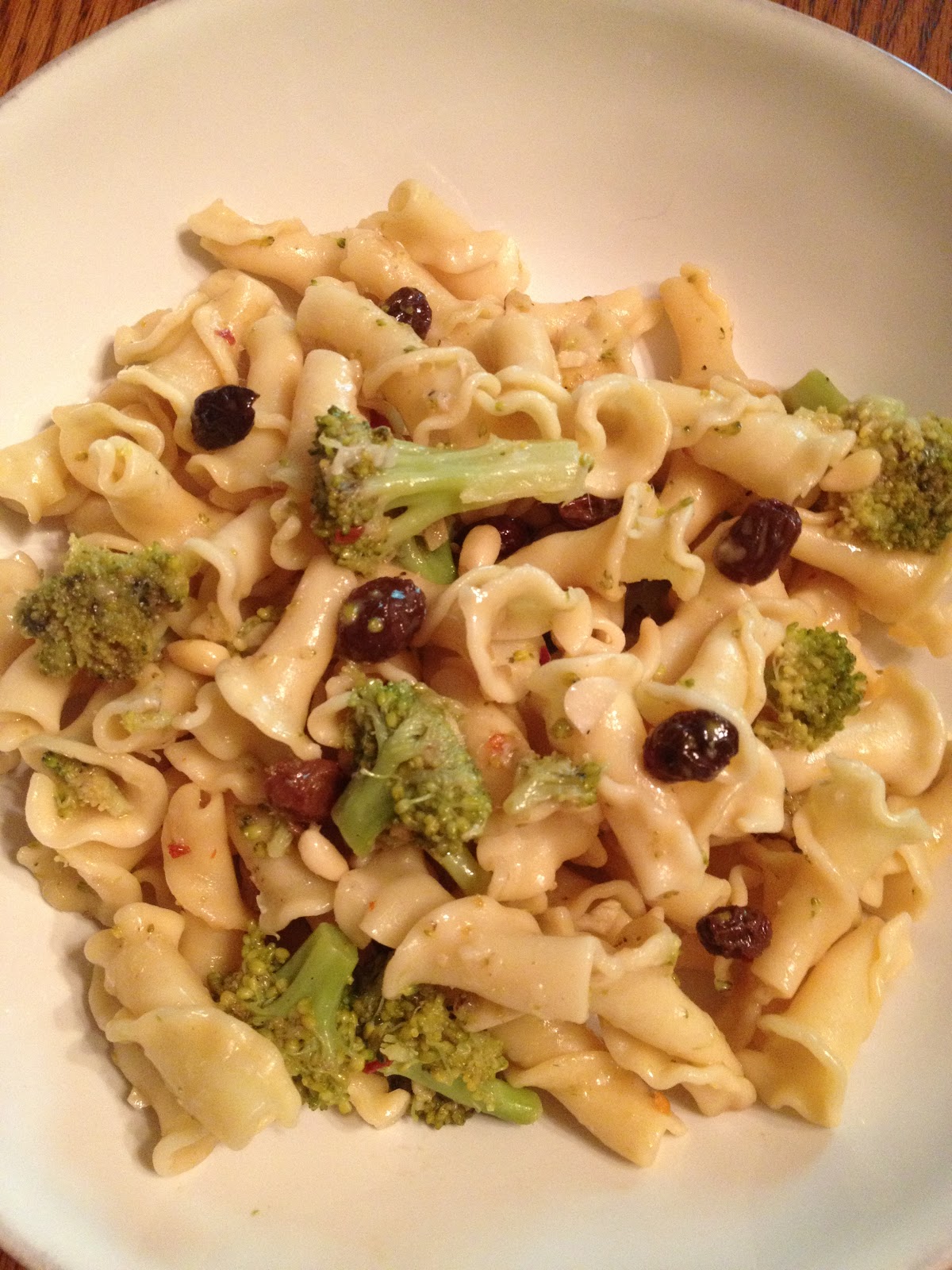
Campanelle with Broccoli, Sicilian Style

I bought a head of broccoli at the market this weekend and wanted it to last more than one meal. Recalling an old recipe for orecchiette with broccoli from a cookbook my dad brought home from Venice, I adjusted the ingredients to fit what I had on hand. The combination of pine nuts, raisins and chile flakes with pasta isn't for everyone, but I think it rocks.

Campanelle with Broccoli, Sicilian Style

1 large head of broccoli
1 box short pasta
4 anchovy fillets (about half a can)
4 cloves garlic, diced
1 small handful of pine nuts
1 even smaller handful of raisins
chile flakes, to taste
grated Pecorino Romano cheese, to taste (1/4-1/2 cup)
4 tbs olive oil
salt 

1. Fill a pasta pot with water and bring to a boil. Add salt and the broccoli. Remove when it's cooked but still firm and soak it in cold water to stop the cooking process. Use the same water to boil your pasta. Remove the pasta about two minutes before it's fully cooked.

2. heat the olive oil in a saucepan, then add the garlic. When the garlic is fragrant but not brown, add the anchovies and chile flakes. Let the anchovies cook until they dissolve. Add a little broccoli water if necessary to keep the pan from drying out. 

3.  Add the pine nuts, raisins, broccoli and simmer for 5 minutes. Then, add the pasta. Mix well and add enough pasta/broccoli water to cover the bottom of the pan. Simmer until the pasta's al dente, add the cheese, toss and serve immediately. 

Thursday, October 11, 2012

Chef Challenge 2012


The Durham Farmer's Market will hold its fourth annual chef challenge Saturday, and I'll be one of the judges!


Chef Billy Cotter of Toast is back to defend his championship, and Geer Street Garden's Andy Magowan returns to challenge him. Chef Christy Quirk of Bull Street Market joins the field for her first challenge.

The secret ingredient will be unveiled at 8:30, and chefs will have two hours to get what they need from the market and cook. Judging begins at 10:30. Frank Stasio of WUNC will be hosting the event and the chefs will offer samples to the crowd.

Join us for great food at the market this Saturday!

Saturday, October 6, 2012

Taming Fresh Ginger

Fresh ginger and turmeric are available at the market these days, but my family recipes have little need for either. The Indian recipes I know call for them in curries, but I wanted to try them in a more direct way.

Turmeric

 Once again I turned to Arati:

The best and healthiest way to use your fresh ginger or turmeric I think would be to julienne them after scraping off the outside skin, then soaking them in lime juice and salt to taste. Let them soak for 3-4 hours or even overnight - they should turn pink! You can then eat it like a garnish with a meal or put in a sandwich with any meat. 

You can use both in marinades too, but then you would have to grind them in a food processor or blender. A roast chicken or any piece of meat would taste wonderful.

Ginger

Sunday, September 30, 2012

Chicken 101


Justin and Kate Meddis of Rose's Market and Sweet Shop performed a chicken butchery workshop at the market this weekend.

Their shop opens in downtown Durham soon and will feature locally sourced cuts of meats, housemade sausages, charcuterie, soups and stocks. They will also offer rotating dinner options and desserts. In the meantime, they're offering butchery classes and teaming up with local farms to create themed dinners, like their upcoming whole hog dinner with Okfuskee Farm.
Justin offered great tips during the chicken workshop. Some of my favorites were:

- Salt moves through meat at the rate of one inch per day, so season your chicken early and generously.

- instead of tying a chicken's legs together before roasting it, cut slits between the leg bones and Achilles tendons and slip one leg through the opposite slit.

- Meat should be room temperature when you cut and cook it. Roasting it straight out of the fridge will reduce the oven's temperature and cook unevenly. it takes about 90 minutes for a refrigerated chicken to reach room temperature.

- After Justin eats roasted chicken, he puts the bones back into a saute pan and roasts them in a 425 degree oven again until they're brown. Then he removes them from the oven and makes a stock. He doesn't season the stock, since you're going to season whatever recipe you add the stock to anyway.

Watching Justin handle his knife during the demonstration reminded me what an art butchery is. Try his tricks next time you buy a bird and check out their shop!

Sunday, September 16, 2012

A Sicilian Salsa Cruda

I wrote about the wonders of fresh tomatoes last summer, particularly in a raw tomato sauce, also known as salsa cruda. I've always viewed salsa crudas as exlcusive to the summer, but that's not always the case in Sicily. Just because tomato season is coming to an end doesn't mean you have to start cooking all of your sauces again.

A recipe for salsa cruda in a Messina News article published in August 2010 provides a variation that includes, but does not necessarily feature, the tomato. It calls for ten cherry tomatoes, but they are just the backdrop for bold flavors like pistachios, almonds, anchovies, capers and orange. It's great with pasta, bread or grilled meats and fish.

I've translated (with help from Google) and copied the recipe below:

SALSA CRUDA ALLA SICILIANA

Ingredients for 4 people:
 

2 tablespoons pistachio nuts 
2 tablespoons almonds
1 tablespoon capers
2 anchovies, in oil
10 Pachino cherry tomatoes 
some basil leaves 
½ an orange, peeled and cut into wedges
extra virgin olive oil
salt (if needed) and pepper.

preparation:
1. Drain the capers and rinse them again under running water.
2. Drain the anchovies.
3. Place capers and anchovies in a blender and blend together with all other ingredients. 

4. Add the oil and season with salt and pepper.

Recipe courtesy of Fragolosi